 OldCourseAssignments OldCourseAssignments
due date: Wednesday Nov 5th 11:59pm (was Monday Nov 3rd, 5pm).
problem #1: deductive reasoning agent: (7 marks) Create a RoboCup agent that uses either an expert system or a planner or a theorem prover or an AND-OR tree. You must use sample code from the AI textbook [4]. You are NOT allowed (i.e., you get a ZERO for this question if you do!) to implement your own planner or theorem prover or... etc (as history indicates that nearly every such attempt in such short time has ended up in failure!). Note that the agent doesn't need to really play soccer; all it needs to do is exhibit the fact that it can take the input from the Soccer Server, use the reasoning algorithm, and do something meaningful. To show that your agent is indeed reasoning and not just reacting:
problem #2: agent in an uncertain environment: (3 marks) Now suppose that the soccer-playing agent has to choose between 2 or more actions, where the outcome of the actions on certain factors (those that determine the welfare of the agent) is uncertain.
Bundle your code and documentation for Q1 and the answer to Q2 in a zip file and submit on Brightspace. Any diagrams must be included directly in the document. Failure to follow any requirement will lead to loss of marks.
This exercise counts for 1/3 of the assignment portion (50%) of the overall grade.
Of course, all the problems are to be completed on your own!
ASSIGNMENT #1
topic: this assignment will evaluate your understanding of general agent architectures.
due date: Monday September 29th, 5pm.
1- Come up with a reactive soccer-playing agent for RoboCup, as per the definition of a reactive agent found in the Wooldridge book. Use Krislet as the starting point for your code. The agent function, i.e. the mapping between the environment state and the action, should be stored in an editable text file separate from the code. One should be able to modify the behavior of your agent by simply editing the text file and without recompiling your code. In a short accompanying document (about half a page and up to a page) tell us how to read, edit and make sense of your agent function definition, give a formal definition of YOUR function (i.e., as applied to your solution) as well a brief intelligible description, describe how your code executes the agent definition, how to run your code, and what kind of behavior to expect when running your code.
2- Now come up with a state-based soccer-playing agent. Ideally, the behaviour of the agent (i.e., the Mealy machine) should again be stored in an editable text file separate from the code, but we're also ok with a hard-coded state machine as long as it is easy to modify it. Again, in a short accompanying document (up to a page or two this time) tell us how to read, edit and make sense of your agent function definition, provide a human-readable Mealy machine diagram (in the extended UML FSM format discussed in class) corresponding to your implementation, describe how your code executes the agent definition, how to run your code, and what kind of behavior to expect when running your code. In addition, the guide should PROVE, using runs derived manually from the state machine or from logs obtained from running the agent, that the behaviour is indeed state-based and not reactive.
For each part of the assignment, bundle your code and your guide in a separate zip file (only the ZIP format will be accepted, not 7z, RAR or other), just like the zip bundle we provided you that contains Krislet and the RoboCup server and monitor. So basically your code should go where the Krislet folder is. I should be able to run your code just like I run Krislet. Store your accompanying document at the top level of the folder hierarchy. Submit your two zip files on Brightspace.
All questions will be judged by the neatness, correctness, usability (the code should be very easy to run, which probably means it should run the same way Krislet is run) and reusability (the behaviors should be easy to edit) of the description, code and approach. Don't forget to address all the questions that were asked!
Do not exceed the page limits. Do not hand-draw diagrams. Failure to comply strictly to the requirements will lead to a loss of marks.
This exercise counts for 1/3 of the assignment portion (50%) of the overall grade.
Of course, all the problems are to be completed on your own!
Hint: do not make things more complicated than they need to be. We don't expect an agent that plays well. We just want an agent that exhibits reactive (in question 1), or state-based (in question 2), soccer behaviour.
ASSIGNMENT #2
due date: Wednesday Nov 13th, 5pm.
problem #1: deductive reasoning agent: (7 marks) Create a RoboCup agent that uses either an expert system or a planner or a theorem prover or an AND-OR tree. You can use sample code from the AI textbook [4] (probably the easiest way) or use code from any other LEGITIMATE library (as long as you have permission and that you include a link to the place you took it from!). But you are NOT allowed to implement your own planner or theorem prover or... etc (as history indicates that nearly every such attempt in such short time has ended up in failure!). Note that the agent doesn't need to really play soccer; all it needs to do is exhibit the fact that it can take the input from the Soccer Server, use the reasoning algorithm, and do something meaningful. To show that your agent is indeed reasoning and not just reacting:
problem #2: agent in an uncertain environment: (3 marks) Now suppose that the soccer-playing agent has to choose between 2 or more actions, where the outcome of the actions on certain factors (those that determine the welfare of the agent) is uncertain.
Bundle your code and documentation for Q1 and the answer to Q2 in a zip file and submit on Brightspace. Failure to follow any requirement will lead to loss of marks.
This exercise counts for 1/3 of the assignment portion (50%) of the overall grade.
Of course, all the problems are to be completed on your own!
ASSIGNMENT #1
topic: this assignment will evaluate your understanding of general agent architectures.
due date: Monday September 30th, 5pm, 2024.
1- Come up with a reactive soccer-playing agent for RoboCup, as per the definition of a reactive agent found in the Wooldridge book. Use Krislet as the starting point for your code. The agent function, i.e. the mapping between the environment state and the action, should be stored in an editable text file separate from the code. One should be able to modify the behavior of your agent by simply editing the text file and without recompiling your code. In a short guide (about half a page and up to a page) tell us how to read, edit and make sense of your agent function definition, give a brief intelligible description of the function, describe how your code executes the agent definition, how to run your code, and what kind of behavior to expect when running your code.
2- Now come up with a state-based soccer-playing agent. Ideally, the behaviour of the agent (i.e., the Mealy machine) should again be stored in an editable text file separate from the code, but we're also ok with a hard-coded state machine as long as it is easy to modify it. Again, in a short guide (up to a page or two this time) tell us how to read, edit and make sense of your agent function definition, provide a human-readable Mealy machine diagram (in the extended UML FSM format discussed in class) corresponding to your implementation, describe how your code executes the agent definition, how to run your code, and what kind of behavior to expect when running your code. In addition, the guide should PROVE, using runs derived manually from the state machine or from logs obtained from running the agent, that the behaviour is indeed state-based and not reactive.
For each part of the assignment, bundle your code and your guide in a separate zip file, just like the zip bundle we provided you that contains Krislet and the RoboCup server and monitor. So basically your code should go where the Krislet folder is. I should be able to run your code just like I run Krislet. Store your guide at the top level of the folder hierarchy. Submit your two zip files on Brightspace.
All questions will be judged by the neatness, correctness, usability (the code should be very easy to run, which probably means it should run the same way Krislet is run) and reusability (the behaviors should be easy to edit) of the description, code and approach. Don't forget to address all the questions that were asked!
Do not exceed the page limits. Do not hand-draw diagrams. Failure to comply strictly to the requirements will lead to a loss of marks.
This exercise counts for 1/3 of the assignment portion (50%) of the overall grade.
Of course, all the problems are to be completed on your own!
Hint: do not make things more complicated than they need to be. We don't expect an agent that plays well. We just want an agent that exhibits reactive (in question 1), or state-based (in question 2), soccer behaviour.
ASSIGNMENT #2
due date: Thursday Nov 9th, 5pm.
problem #1: deductive reasoning agent: (7 marks) Create a RoboCup agent that uses either an expert system or a planner or a theorem prover or an AND-OR tree. You can use sample code from the AI textbook [4] (probably the easiest way) or use code from any other LEGITIMATE library (as long as you have permission and that you include a link to the place you took it from!). Note that the agent doesn't need to really play soccer; all it needs to do is exhibit the fact that it can take the input from the Soccer Server, use the reasoning algorithm, and do something meaningful. To show that your agent is indeed reasoning and not just reacting:
problem #2: agent in an uncertain environment: (3 marks) Now suppose that the soccer-playing agent has to choose between 2 or more actions, where the outcome of the actions on certain factors (those that determine the welfare of the agent) is uncertain.
Bundle your code and documentation for Q1 and the answer to Q2 in a zip file and submit on Brightspace. Failure to follow any requirement will lead to loss of marks.
This exercise counts for 1/3 of the assignment portion (50%) of the overall grade.
Of course, all the problems are to be completed on your own!
ASSIGNMENT #1
topic: this assignment will evaluate your understanding of general agent architectures.
due date: Tuesday October 3rd, 5pm, 2023.
1- Come up with a reactive soccer-playing agent for RoboCup, as per the definition of a reactive agent found in the Wooldridge book. Use Krislet as the starting point for your code. The agent function, i.e. the mapping between the environment state and the action, should be stored in an editable text file separate from the code. One should be able to modify the behavior of your agent by simply editing the text file and without recompiling your code. In a short guide (about half a page and up to a page) tell us how to read, edit and make sense of your agent function definition, give a brief intelligible description of the function, describe how your code executes the agent definition, how to run your code, and what kind of behavior to expect when running your code.
2- Now come up with a state-based soccer-playing agent. Ideally, the behaviour of the agent (i.e., the state machine) should again be stored in an editable text file separate from the code, but we're also ok with a hard-coded state machine as long as it is easy to modify it. Again, in a short guide (up to a page or two this time) tell us how to read, edit and make sense of your agent function definition, provide a human-readable finite state machine diagram (in the extended UML FSM format discussed in class) corresponding to your implementation, describe how your code executes the agent definition, how to run your code, and what kind of behavior to expect when running your code. In addition, the guide should PROVE, using runs derived manually from the state machine or from logs obtained from running the agent, that the behaviour is indeed state-based and not reactive.
For each part of the assignment, bundle your code and your guide in a separate zip file, just like the zip bundle we provided you that contains Krislet and the RoboCup server and monitor. So basically your code should go where the Krislet folder is. I should be able to run your code just like I run Krislet. Store your guide at the top level of the folder hierarchy. Submit your two zip files on Brightspace.
All questions will be judged by the neatness, correctness, usability (the code should be very easy to run, which probably means it should run the same way Krislet is run) and reusability (the behaviors should be easy to edit) of the description, code and approach.
Do not exceed the page limits. Do not hand-draw diagrams. Failure to comply strictly to the requirements will lead to a loss of marks.
This exercise counts for 1/3 of the assignment portion (50%) of the overall grade.
Of course, all the problems are to be completed on your own!
Hint: do not make things more complicated than they need to be. We don't expect an agent that plays well. We just want an agent that exhibits reactive (in question 1), or state-based (in question 2), soccer behaviour.
ASSIGNMENT #2
due date: beginning of class on Tuesday November 8th, 2022.
problem #1: deductive reasoning agent: (7 marks) Create a RoboCup agent that uses either an expert system or a planner or a theorem prover or an AND-OR tree. You can use sample code from the AI textbook [4] (probably the easiest way) or use code from any other LEGITIMATE library (as long as you have permission and that you include a link to the place you took it from!). Note that the agent doesn't need to really play soccer; all it needs to do is exhibit the fact that it can take the input from the Soccer Server, use the reasoning algorithm, and do something meaningful. To show that your agent is indeed reasoning and not just reacting:
problem #2: agent in an uncertain environment: (3 marks) Now suppose that the soccer-playing agent has to choose between 2 or more actions, where the outcome of the actions on certain factors (those that determine the welfare of the agent) is uncertain.
Bundle your code and documentation for Q1 and the answer to Q2 in a zip file and submit on Brightspace. Failure to follow any requirement will lead to loss of marks.
This exercise counts for 1/3 of the assignment portion (50%) of the overall grade.
Of course, all the problems are to be completed on your own!
ASSIGNMENT #1
topic: this assignment will evaluate your understanding of general agent architectures.
due date: Tuesday October 4th, 6pm, 2022.
1- Come up with a reactive soccer-playing agent for RoboCup, as per the definition of a reactive agent found in the Wooldridge book. Use Krislet as the starting point for your code. The agent function, i.e. the mapping between the environment state and the action, should be stored in an editable text file separate from the code. One should be able to modify the behavior of your agent by simply editing the text file and without recompiling your code. In a short guide (about half a page and up to a page) tell us how to read, edit and make sense of your agent function definition, give a brief intelligible description of the function, describe how your code executes the agent definition, how to run your code, and what kind of behavior to expect when running your code.
2- Now come up with a state-based soccer-playing agent. Ideally, the behaviour of the agent (i.e., the state machine) should again be stored in an editable text file separate from the code, but we're also ok with a hard-coded state machine as long as it is easy to modify it. Again, in a short guide (up to a page or two this time) tell us how to read, edit and make sense of your agent function definition, provide a human-readable finite state machine diagram (in the extended UML FSM format discussed in class) corresponding to your implementation, describe how your code executes the agent definition, how to run your code, and what kind of behavior to expect when running your code. In addition, the guide should PROVE, using runs derived manually from the state machine or from logs obtained from running the agent, that the behaviour is indeed state-based and not reactive.
For each part of the assignment, bundle your code and your guide in a separate zip file, just like the zip bundle we provided you that contains Krislet and the RoboCup server and monitor. So basically your code should go where the Krislet folder is. I should be able to run your code just like I run Krislet. Store your guide at the top level of the folder hierarchy. Submit your two zip files on Brightspace.
All questions will be judged by the neatness, correctness, usability (the code should be very easy to run, which probably means it should run the same way Krislet is run) and reusability (the behaviors should be easy to edit) of the description, code and approach.
Do not exceed the page limits. Do not hand-draw diagrams. Failure to comply strictly to the requirements will lead to a loss of marks.
This exercise counts for 1/3 of the assignment portion (50%) of the overall grade.
Of course, all the problems are to be completed on your own!
Hint: do not make things more complicated than they need to be. We don't expect an agent that plays well. We just want an agent that exhibits reactive (in question 1), or state-based (in question 2), behaviour.
ASSIGNMENT #2
due date: beginning of class on Monday November 15th, 2021.
problem #1: deductive reasoning agent: (7 marks) Create a RoboCup agent that uses either an expert system or a planner or a theorem prover. You can use sample code from the AI textbook [4] (probably the easiest way), implement the algorithm yourself (but that is additional burden on you to implement the algorithms correctly!), or use code from any other place (as long as you have permission and that you include a link to the site you took it from!). Note that the agent doesn't need to really play soccer; all it needs to do is exhibit the fact that it can take the input from the Soccer Server, use the reasoning algorithm, and do something meaningful. To show that your agent is indeed reasoning and not just reacting:
problem #2: agent in an uncertain environment: (3 marks) Now suppose that the soccer-playing agent has to choose between 2 or more actions, where the outcome of the actions on certain factors (those that determine the welfare of the agent) is uncertain.
Bundle your code and documentation for Q1 and the answer to Q2 in a zip file and submit on Brightspace. Failure to follow any requirement will lead to loss of marks.
This exercise counts for 1/3 of the assignment portion (50%) of the overall grade.
Of course, all the problems are to be completed on your own!
ASSIGNMENT #1
topic: this assignment will evaluate your understanding of general agent architectures.
due date: Monday February 1st, 6pm, 2021.
1- Come up with a reactive soccer-playing agent for RoboCup, as per the definition of a reactive agent found in the Wooldridge book. Use Krislet as the starting point for your code. The agent function, i.e. the mapping between the environment state and the action, should be stored in an editable text file separate from the code. One should be able to modify the behavior of your agent by simply editing the text file and without recompiling your code. In a short guide (about half a page and up to a page) tell us how to read, edit and make sense of your agent function definition, give a brief intelligible description of the function, describe how your code executes the agent definition, how to run your code, and what kind of behavior to expect when running your code.
2- Now come up with a state-based soccer-playing agent. Ideally, the behaviour of the agent (i.e., the state machine) should again be stored in an editable text file separate from the code, but we're also ok with a hard-coded state machine as long as it is easy to modify it. Again, in a short guide (up to a page or two this time) tell us how to read, edit and make sense of your agent function definition, provide a human-readable finite state machine diagram (ideally in the extended UML FSM format discussed in class) corresponding to your implementation, describe how your code executes the agent definition, how to run your code, and what kind of behavior to expect when running your code. In addition, the guide should PROVE, using runs derived manually from the state machine or from logs obtained from running the agent, that the behaviour is indeed state-based and not reactive.
For each part of the assignment, bundle your code and your guide in a separate zip file, just like the zip bundle we provided you that contains Krislet and the RoboCup server and monitor. So basically your code should go where the Krislet folder is. I should be able to run your code just like I run Krislet. Store your guide at the top level of the folder hierarchy. Submit your two zip files on Cu Learn.
All questions will be judged by the neatness, correctness, usability (the code should be very easy to run, which probably means it should run the same way Krislet is run) and reusability (the behaviors should be easy to edit) of the description, code and approach.
Do not exceed the page limits. Do not hand-draw diagrams. Failure to comply strictly to the requirements will lead to a loss of marks.
This exercise counts for 1/3 of the assignment portion (50%) of the overall grade.
Of course, all the problems are to be completed on your own!
Hint: do not make things more complicated than they need to be. We don't expect an agent that plays well. We just want an agent that exhibits reactive (in question 1), or state-based (in question 2), behaviour.
ASSIGNMENT #2
due date: beginning of class on Wednesday March 4th, 2020.
problem #1: AgentReasoning: (7 marks) Create a RoboCup agent that uses either an expert system or planning or an AND/OR tree. You can use sample code from the AI textbook [4] (probably the easiest way), implement the algorithm yourself, or use code from any other place (as long as you have permission and that you include a link to the site you took it from!). Note that the agent doesn't need to really play soccer; all it needs to do is exhibit the fact that it can take the input from the Soccer Server, use the reasoning algorithm, and do something meaningful. To prove that your agent is indeed reasoning and not just reacting:
problem #2: agent in an uncertain environment: (3 marks) Now suppose that the soccer-playing agent has to choose between 2 or more actions, where the outcome of the actions on certain factors (those that determine the welfare of the agent) is uncertain.
The assignment should be typed. Only hard copy submissions are accepted. Failure to follow any requirement will lead to loss of marks.
This exercise counts for 1/3 of the assignment portion (50%) of the overall grade.
Of course, all the problems are to be completed on your own!
ASSIGNMENT #1
topic: this assignment will evaluate your understanding of general agent architectures.
due date: beginning of class on Wednesday February 5th, 2020.
1- Come up with a reactive soccer-playing agent for RoboCup, as per the definition of a reactive agent found in the Wooldridge book. You can use Krislet as the starting point for your code. The agent function, i.e. the mapping between the environment state and the action, should be stored in an editable text file separate from the code. One should be able to modify the behavior of your agent by simply editing the text file and without recompiling your code. In a short guide (about half a page and up to a page) tell us how to read, edit and make sense of your agent function definition, give a brief intelligible description of the function, describe how your code executes the agent definition, how to run your code, and what kind of behavior to expect when running your code.
2- Now come up with a state-based soccer-playing agent. Ideally, the behaviour of the agent (i.e., the state machine) should again be stored in an editable text file separate from the code, but we're also ok with a hard-coded state machine as long as it is easy to modify it. Again, in a short guide (up to a page or two this time) tell us how to read, edit and make sense of your agent function definition, provide a human-readable finite state machine diagram (ideally in the extended UML FSM format discussed in class) corresponding to your implementation, describe how your code executes the agent definition, how to run your code, and what kind of behavior to expect when running your code. In addition, the guide should PROVE, using runs derived manually from the state machine or from logs obtained from running the agent, that the behaviour is indeed state-based and not reactive.
If you have access to the course on cuLearn, you can use it to submit your code. If not, in both your short guides, provide a URL (a short one! please use a URL shortener such as bit.ly or goo.gl) to where one can download your code.
All questions will be judged by the neatness, correctness, usability (the code should be very easy to run, which probably means it should run the same way Krislet is run) and reusability (the behaviors should be easy to edit) of the description, code and approach.
The assignment (other than the code) should be typed (don't draw diagrams with a pencil!) and should not exceed the page limits. Only hard copy submissions are accepted (i.e. do NOT just upload your answers to cuLearn! Print and bring to me!). Failure to comply strictly to the requirements will lead to a loss of marks.
This exercise counts for 1/3 of the assignment portion (50%) of the overall grade.
Of course, all the problems are to be completed on your own!
Hint: do not make things more complicated than they need to be. We don't expect an agent that plays well. We just want an agent that exhibits reactive (in question 1), or state-based (in question 2), behaviour.
ASSIGNMENT #2
due date: beginning of class on Tuesday March 5th, 2019.
problem #1: AgentReasoning: (7 marks) Create a RoboCup agent that uses either an AND/OR tree, an expert system or planning. You can use sample code from the AI textbook [4] (probably the easiest way), implement the algorithm yourself, or use code from any other place (as long as you have permission and that you include a link to the site you took it from!). Note that the agent doesn't need to really play soccer; all it needs to do is exhibit the fact that it can take the input from the Soccer Server, use the reasoning algorithm, and do something meaningful. To prove that your agent is indeed reasoning and not just reacting:
problem #2: agent in an uncertain environment: (3 marks) Now suppose that the soccer-playing agent has to choose between 2 or more actions, where the outcome of the actions on certain factors (those that determine the welfare of the agent) is uncertain.
The assignment should be typed. Only hard copy submissions are accepted. Failure to follow any requirement will lead to loss of marks.
This exercise counts for 1/3 of the assignment portion (50%) of the overall grade.
Of course, all the problems are to be completed on your own!
ASSIGNMENT #1
topic: this assignment will evaluate your understanding of general agent architectures.
due date: beginning of class on Tuesday January 29th, 2019.
1- Come up with a reactive soccer-playing agent for RoboCup, as per the definition of a reactive agent found in the Wooldridge book. You can use Krislet as the starting point for your code. The agent function, i.e. the mapping between the environment state and the action, should be stored in an editable text file separate from the code. One should be able to modify the behavior of your agent by simply editing the text file and without recompiling your code. In a short guide (about half a page and up to a page) tell us how to read, edit and make sense of your agent function definition, give a brief intelligible description of the function, describe how your code executes the agent definition, how to run your code, and what kind of behavior to expect when running your code.
2- Now come up with a state-based soccer-playing agent. Ideally, the behaviour of the agent (i.e., the state machine) should again be stored in an editable text file separate from the code, but we're also ok with a hard-coded state machine as long as it is easy to modify it (see for example the State Pattern). Again, in a short guide (up to a page or two this time) tell us how to read, edit and make sense of your agent function definition, provide a human-readable finite state machine diagram corresponding to your implementation, describe how your code executes the agent definition, how to run your code, and what kind of behavior to expect when running your code. In addition, the guide should PROVE, using runs derived manually from the state machine or from logs obtained from running the agent, that the behaviour is indeed state-based and not reactive.
If you have access to the course on cuLearn, you can use it submit your code. If not, in both your short guides, provide a URL (a short one! please use a URL shortener such as bit.ly or goo.gl) to where one can download your code.
All questions will be judged by the neatness, correctness, usability (the code should be very easy to run) and reusability (the behaviors should be easy to edit) of the description, code and approach.
The assignment should be typed and should not exceed the page limits. Only hard copy submissions are accepted (i.e. do NOT just upload your answers to cuLearn! Print and bring to me!). Failure to comply strictly to the requirements will lead to a loss of marks.
This exercise counts for 1/3 of the assignment portion (50%) of the overall grade.
Of course, all the problems are to be completed on your own!
Hint: do not make things more complicated than they need to be. We don't expect an agent that plays well. We just want an agent that exhibits reactive (in question 1), or state-based (in question 2), behaviour.
ASSIGNMENT #2
due date: beginning of class on Thursday June 7th, 2018.
problem #1: AgentReasoning: (7 marks) Create a RoboCup agent that uses either an AND/OR tree, an expert system or planning. You can use sample code from the AI textbook [4] (probably the easiest way), implement the algorithm yourself, or use code from any other place (as long as you have permission and that you include a link to the site you took it from!). Note that the agent doesn't need to really play soccer; all it needs to do is exhibit the fact that it can take the input from the Soccer Server, use the reasoning algorithm, and do something meaningful. To prove that your agent is indeed reasoning and not just reacting:
problem #2: agent in an uncertain environment: (3 marks) Now suppose that the soccer-playing agent has to choose between 2 or more actions, where the outcome of the actions on certain factors (those that determine the welfare of the agent) is uncertain.
The assignment should be typed. Only hard copy submissions are accepted. Failure to follow any requirement will lead to loss of marks.
This exercise counts for 1/3 of the assignment portion (50%) of the overall grade.
Of course, all the problems are to be completed on your own!
Here's the third problem that I considered posting but that you won't have to do:
problem #3: MachineLearning Come up with a hand-crafted AARF file representing a possible log of the behaviour of a soccer-playing agent (note: this doesn't have to be related to RoboCup at all). The non-categorical attributes/features could be anything in the environment that is potentially relevant to the agent's decision making (e.g., the position of particular objects), and the categorical attribute should be the agent's action. Now use the AARF in Weka to generate a decision tree. You should hand-craft your file in such a way that the resulting decision tree uses at least two decision branches. The file doesn't need to be long at all (no more than a page). In your submission, use one page to include the AARF file, and another page to describe what features and values you used in the AARF file, and to include the resulting decision tree.
ASSIGNMENT #1
topic: this assignment will evaluate your understanding of general agent architectures.
due date: beginning of class on Thursday May 24th, 2018.
1- Come up with a reactive soccer-playing agent for RoboCup, as per the definition of a reactive agent found in the Wooldridge book. You can use Krislet as the starting point for your code. The agent function, i.e. the mapping between the environment state and the action, should be stored in an editable text file separate from the code. One should be able to modify the behavior of your agent by simply editing the text file and without recompiling your code. In a short guide (about half a page and up to a page) tell us how to read, edit and make sense of your agent function definition, give a brief intelligible description of the function, describe how your code executes the agent definition, how to run your code, and what kind of behavior to expect when running your code.
2- Now come up with a state-based soccer-playing agent. Ideally, the behaviour of the agent (i.e., the state machine) should again be stored in an editable text file separate from the code, but we're also ok with a hard-coded state machine as long as it is easy to modify it (see for example the State Pattern). Again, in a short guide (up to a page or two this time) tell us how to read, edit and make sense of your agent function definition, provide a human-readable finite state machine diagram corresponding to your implementation, describe how your code executes the agent definition, how to run your code, and what kind of behavior to expect when running your code. In addition, the guide should PROVE, using runs derived manually from the state machine or from logs obtained from running the agent, that the behaviour is indeed state-based and not reactive.
In both your short guides, provide a URL (a short one!) to where one can download your code.
All questions will be judged by the neatness, correctness, usability (the code should be very easy to run) and reusability (the behaviors should be easy to edit) of the description, code and approach.
The assignment should be typed and should not exceed the page limits. Only hard copy submissions are accepted. Failure to comply strictly to the requirements will lead to a loss of marks.
This exercise counts for 1/3 of the assignment portion (50%) of the overall grade.
Of course, all the problems are to be completed on your own!
Hint: do not make things more complicated than they need to be. We don't expect an agent that plays well. We just want an agent that exhibits reactive (in question 1), or state-based (in question 2), behaviour.
ASSIGNMENT #2
due date: beginning of class on Tuesday June 6th.
problem #1: AgentReasoning (6 marks): Create a RoboCup agent that uses either an AND/OR tree, an expert system or planning. You can use sample code from the AI textbook [4] (probably the easiest way), implement the algorithm yourself, or use code from any other place (as long as you have permission and that you include a link to the site you took it from!). Note that the agent doesn't need to really play soccer; all it needs to do is exhibit the fact that it can take the input from the Soccer Server, use the reasoning algorithm, and do something meaningful. To prove that your agent is indeed reasoning and not just reacting:
problem #2: MachineLearning (3 marks) Come up with a hand-crafted AARF file representing a possible log of the behaviour of a soccer-playing agent (note: this doesn't have to be related to RoboCup at all). The non-categorical attributes/features could be anything in the environment that is potentially relevant to the agent's decision making (e.g., the position of particular objects), and the categorical attribute should be the agent's action. Now use the AARF in Weka to generate a decision tree. You should hand-craft your file in such a way that the resulting decision tree uses at least two decision branches. The file doesn't need to be long at all (no more than a page). In your submission, use one page to include the AARF file, and another page to describe what features and values you used in the AARF file, and to include the resulting decision tree.
problem #3: agent in an uncertain environment: (3 marks) Now suppose that the soccer-playing agent has to choose between 2 or more actions, where the outcome of the actions on certain factors (those that determine the welfare of the agent) is uncertain.
The assignment should be typed. Only hard copy submissions are accepted. Failure to follow any requirement will lead to loss of marks.
This exercise counts for 1/3 of the assignment portion (50%) of the overall grade.
Of course, all the problems are to be completed on your own!
ASSIGNMENT #1
topic: this assignment will evaluate your understanding of general agent architectures.
due date: beginning of class on Tuesday May 23rd, 2017.
1- Come up with a reactive soccer-playing agent for RoboCup, as per the definition of a reactive agent found in the Wooldridge book. You can use Krislet as the starting point for your code. The agent function, i.e. the mapping between the environment state and the action, should be stored in an editable text file separate from the code. One should be able to modify the behavior of your agent by simply editing the text file and without recompiling your code. In a short guide (about half a page and up to a page) tell us how to read, edit and make sense of your agent function definition, give a brief intelligible description of the function, describe how your code executes the agent definition, how to run your code, and what kind of behavior to expect when running your code.
2- Now come up with a state-based soccer-playing agent. Ideally, the behaviour of the agent (i.e., the state machine) should again be stored in an editable text file separate from the code, but we're also ok with a hard-coded state machine as long as it is easy to modify it (see for example the State Pattern). Again, in a short guide (up to a page or two this time) tell us how to read, edit and make sense of your agent function definition, provide a human-readable finite state machine diagram corresponding to your implementation, describe how your code executes the agent definition, how to run your code, and what kind of behavior to expect when running your code. In addition, the guide should PROVE, using runs derived manually from the state machine, that the behaviour is indeed state-based and not reactive.
In both your short guides, provide a URL to where one can download your code.
All questions will be judged by the neatness, correctness, usability (the code should be very easy to run) and reusability (the behaviors should be easy to edit) of the description, code and approach.
The assignment should be typed and should not exceed the page limits. Only hard copy submissions are accepted. Failure to comply strictly to the requirements will lead to a loss of marks.
This exercise counts for 1/3 of the assignment portion (50%) of the overall grade.
Of course, all the problems are to be completed on your own!
Final hint: do not make things more complicated than they need to be. We don't expect an agent that plays well. We just want an agent that exhibits reactive (in question 1), or state-based (in question 2), behaviour.
ASSIGNMENT #2
topic: this assignment will evaluate your understanding of how to design agents in various types of environments.
due date: beginning of class on Monday June 6th.
problem #1: AgentPlanning: We want to use a planning algorithm using STRIPS operators, based on the notations and example described in [2] and [3], to determine a course of action for a soccer-playing agent. Here we won't worry about the planning algorithm itself, but about setting up the description of the world and of the operators available to the agent.
problem #2: First Order Logic Read about Situation Calculus (for example in 10.4.2 of R&N) and use it to model the actions of a soccer-playing agent, and the effects those actions have on the environment in a few logical sentences. Try to make this agent as similar as possible to the one you came up with in problem#1.
1/2 a page max!
problem #3: agent in an uncertain environment: now suppose that the soccer-playing agent has to choose between 2 or more actions, where the outcome of the actions on certain factors (those that determine the welfare of the agent) is uncertain.
The assignment should be typed. Only hard copy submissions are accepted. Failure to follow any requirement will lead to loss of marks.
This exercise counts for 1/3 of the assignment portion (50%) of the overall grade.
Of course, all the problems are to be completed on your own!
ASSIGNMENT #1
topic: this assignment will evaluate your understanding of general agent architectures.
due date: beginning of class on Wednesday May 25th, 2016.
Let's model the behaviour of a soccer-playing agent, using the PEAS methodology discussed in class (and discussed extensively in the Russell and Norvig textbook), as well as the agent-environment formalism also discussed in class and in the Wooldridge textbook. Whether this soccer game takes place in a real or virtual environment is not really relevant to this exercise; I'll leave it up to you to make it simple yet realistic enough to be recognizable as soccer.
The assignment should be typed and SHOULD NOT EXCEED 4 PAGES. Page limits should be strictly respected (only the first 4 pages will be marked!!!). Choosing fonts that are too small in order to fit within the limits is NOT acceptable! Only hard copy submissions are accepted. Again, failure to comply strictly to the requirements will lead to a loss of marks.
This exercise counts for 1/3 of the assignment portion (50%) of the overall grade.
Of course, all the problems are to be completed on your own!
topic: this assignment will evaluate your understanding of how to design agents in various types of environments.
due date: beginning of class on Monday March 3rd.
problem #1: AgentPlanning: We want to use a planning algorithm using STRIPS operators, based on the notations and example described in [2] and [3], to determine a course of action for a soccer-playing agent. Here we won't worry about the planning algorithm itself, but about setting up the description of the world and of the operators available to the agent.
problem #2: First Order Logic Read about Situation Calculus (for example in 10.4.2 of R&N) and use it to model the actions of a soccer-playing agent, and the effects those actions have on the environment in a few logical sentences. Try to make this agent as similar as possible to the one you came up with in problem#1.
1/2 a page max!
problem #3: agent in an uncertain environment: now suppose that the soccer-playing agent has to choose between 2 or more actions, where the outcome of the actions on certain factors (those that determine the welfare of the agent) is uncertain.
The assignment should be typed. Only hard copy submissions are accepted. Failure to follow any requirement will lead to loss of marks.
This exercise counts for 1/3 of the assignment portion (50%) of the overall grade.
Of course, all the problems are to be completed on your own!
ASSIGNMENT #1
topic: this assignment will evaluate your understanding of general agent architectures.
due date: beginning of class on Tuesday February 12th, 2014.
Let's model the behaviour of a soccer-playing agent. Whether this takes place in a real or virtual environment is not really relevant to this exercise; I'll leave it up to you to make it simple yet realistic enough to be recognizable as soccer.
The assignment should be typed and SHOULD NOT EXCEED 4 PAGES. Page limits should be strictly respected (only the first 4 pages will be marked!!!). Choosing fonts that are too small in order to fit within the limits is NOT acceptable! Only hard copy submissions are accepted. Again, failure to comply strictly to the requirements will lead to a loss of marks.
This exercise counts for 1/3 of the assignment portion (50%) of the overall grade.
Of course, all the problems are to be completed on your own!
ASSIGNMENT #2
topic: this assignment will evaluate your understanding of how to design agents in various types of environments.
due date: beginning of class on Tuesday March 5th.
problem #1: AgentPlanning: We want to use a planning algorithm using STRIPS operators, based on the notations and example described in [2] and [3], to determine a course of action for a soccer-playing agent. Here we won't worry about the planning algorithm itself, but about setting up the description of the world and of the operators available to the agent.
problem #2: First Order Logic Read about Situation Calculus (for example in 10.4.2 of R&N) and use it to model the actions of a soccer-playing agent, and the effects those actions have on the environment in a few logical sentences. Try to make this agent as similar as possible to the one you came up with in problem#1.
1/2 a page max!
problem #3: agent in an uncertain environment: now suppose that the soccer-playing agent has to choose between 2 or more actions, where the outcome of the actions on certain factors (those that determine the welfare of the agent) is uncertain.
The assignment should be typed. Only hard copy submissions are accepted. Failure to follow any requirement will lead to loss of marks.
This exercise counts for 1/3 of the assignment portion (50%) of the overall grade.
Of course, all the problems are to be completed on your own!
ASSIGNMENT #1
topic: this assignment will evaluate your understanding of general agent architectures.
due date: beginning of class on Tuesday February 12th, 2012.
Let's model the behaviour of a soccer-playing agent. Whether this takes place in a real or virtual environment is not really relevant to this exercise; I'll leave it up to you to make it simple yet realistic enough to be recognizable as soccer.
The assignment should be typed and SHOULD NOT EXCEED 4 PAGES. Page limits should be strictly respected (only the first 4 pages will be marked!!!). Choosing fonts that are too small in order to fit within the limits is NOT acceptable! Only hard copy submissions are accepted. Again, failure to comply strictly to the requirements will lead to a loss of marks.
This exercise counts for 1/3 of the assignment portion (50%) of the overall grade.
Of course, all the problems are to be completed on your own!
topic: this assignment will evaluate your understanding of how to design agents in various types of environments.
due date: beginning of class on Tuesday Feb 28th.
problem #1: AgentPlanning: We want to use a planning algorithm using STRIPS operators, based on the notations and example described in [2] and [3], to determine a course of action for a soccer-playing agent. Here we won't worry about the planning algorithm itself, but about setting up the description of the world and of the operators available to the agent.
problem #2: expert systems: come up with a set of expert system rules used by a soccer agent to update its set of beliefs. Show, with an example, how receiving an update from the environment leads to inferring new beliefs by triggering rules via forward chaining.
1 page max!
problem #3: agent in an uncertain environment: now suppose that the soccer-playing agent has to choose between 2 or more actions, where the outcome of the actions on certain factors (those that determine the welfare of the agent) is uncertain.
The assignment should be typed. Only hard copy submissions are accepted. Failure to follow any requirement will lead to loss of marks.
This exercise counts for 1/3 of the assignment portion (50%) of the overall grade.
Of course, all the problems are to be completed on your own!
topic: this assignment will evaluate your understanding of general agent architectures.
due date: beginning of class on Tuesday February 7th, 2012.
Let's model the behaviour of a soccer-playing agent. Whether this takes place in a real or virtual environment is not really relevant to this exercise; I'll leave it up to you to make it simple yet realistic enough to be recognizable as soccer.
The assignment should be typed and SHOULD NOT EXCEED 4 PAGES. Page limits should be strictly respected (only the first 4 pages will be marked!!!). Choosing fonts that are too small in order to fit within the limits is NOT acceptable! Only hard copy submissions are accepted. Again, failure to comply strictly to the requirements will lead to a loss of marks.
This exercise counts for 1/3 of the assignment portion (50%) of the overall grade.
Of course, all the problems are to be completed on your own!
topic: this assignment will evaluate your understanding of AgentReasoning and AgentAdaptability.
due date: beginning of class on Monday November 15th, 2010.
problem #1: AgentPlanning: We want to use a planning algorithm using STRIPS operators, based on the notations and example described in [2] and [3], to determine a course of action for a soccer-playing agent. Here we won't worry about the planning algorithm itself, but about setting up the description of the world and of the operators available to the agent.
problem #2: MachineLearning: We want to use MachineLearning to imitate the behavior of a fellow soccer-playing agent. To do this we would record its behavior (dash, turn, and kick actions) in various situations (as described by the combination of various non-categorical attributes) in a log file. Come up with a set of learning samples corresponding to such a log file, then feed the samples to Weka and generate a resulting decision tree. One page should the describe the categorical and non-categorical attributes of the problem, and list the samples in a table (10-20 rows), and another page should display the tree output by Weka. The tree should have *at least 3 branching points*.
problem #3: agent in an uncertain or partially inaccessible environment: now suppose that the soccer-playing agent has to choose between 2 or more actions which chances of success depend on certain aspects of the environment.
The assignment should be typed. Only hard copy submissions are accepted. Failure to follow any requirement will lead to loss of marks.
This exercise counts for 1/3 of the assignment portion (50%) of the overall grade.
Of course, all the problems are to be completed on your own!
ASSIGNMENT #1
topic: this assignment will evaluate your understanding of the general agent architecture, adversarial search and the application of propositional logic to building deductive agents.
due date: beginning of class on Wednesday October 20th, 2010.
question #1: general agent architecture, environments, states, state transformer functions
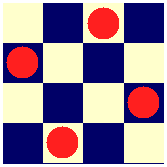
In the first round of the game, the player can choose 75 or 5. The number of boxes is then reduced to five. The second player then chooses the remaining leftmost or rightmost box, and so on.
The assignment should be typed. Page limits should be strictly respected (grades WILL be lost otherwise!). Choosing fonts that are too small in order to fit within the limits is not acceptable! Only hard copy submissions are accepted. Again, failure to comply strictly to the requirements will lead to a loss of marks.
This exercise counts for 1/3 of the assignment portion (50%) of the overall grade.
Of course, all the problems are to be completed on your own!
ASSIGNMENT #2
topic: this assignment will evaluate your understanding of AgentReasoning and AgentAdaptability.
due date: beginning of class on Wednesday November 4th, 2009.
In this assignment we will focus on different approaches for modelling the behavior soccer-playing agent and exploiting the resulting.
problem #1: AgentPlanning: We want to use a planning algorithm using STRIPS operators, based on the notations and example described in [2] and [3], to determine a course of action for a soccer-playing agent. Here we won't worry about the planning algorithm itself, but about setting up the description of the world and of the operators available to the agent.
problem #2: MachineLearning: We want to use MachineLearning to imitate the behavior of a fellow soccer-playing agent. To do this we would record its behavior (dash, turn, and kick actions) in various situations (as described by the combination of various non-categorical attributes) in a log file. Come up with a set of learning samples corresponding to such a log file, then feed the samples to Weka and generate a resulting decision tree. One page should the describe the categorical and non-categorical attributes of the problem, and list the samples in a table (10-20 rows), and another page should display the tree output by Weka. The tree should have *at least 3 branching points*.
problem #3: agent in an uncertain or partially inaccessible environment: now suppose that the soccer-playing agent has to choose between 2 or more actions which chances of success depend on certain aspects of the environment.
The assignment should be typed. Only hard copy submissions are accepted. Failure to follow any requirement will lead to loss of marks.
This exercise counts for 1/3 of the assignment portion (50%) of the overall grade.
Of course, all the problems are to be completed on your own!
ASSIGNMENT #1
topic: this first assignment will get you to model and design simple agents and evaluate your understanding of AgentKnowledgeRepresentation.
due date: beginning of class on Wednesday October 14th, 2008.
question #1: state-based agent:
question #3: research question: read up on Situation Calculus (there is a good section in the Russell & Norvig, or you can use Wikipedia as a starting point) and apply it to (partially) describe a deductive agent that can play at least one aspect of the game of soccer. 1 page max!
All questions will be judged by the quality (formality, correctness, usefulness, reusability...) of the modelling, its description, and its exploitation.
The assignment should be typed. Page limits should be strictly respected (grades WILL be lost otherwise!). Choosing fonts that are too small in order to fit within the limits is not acceptable! Only hard copy submissions are accepted. Again, failure to comply strictly to the requirements will lead to a loss of marks.
This exercise counts for 1/3 of the assignment portion (50%) of the overall grade.
Of course, all the problems are to be completed on your own!
ASSIGNMENT #2
topic: this assignment will evaluate your understanding of AgentReasoning. You are asked to look at the problem of Operating Systems Discovery (OSD)using the techniques discussed in class. The goal of OSD is to guess what operating system is running on a given machine, using the way the machine reacts to various tests. Since you are not expected to know what kind of tests are typically used for OSD, you are free to imagine any kind of test that you think makes sense. You will not be judged on the pertinence of the tests.
due date: beginning of class on Tuesday October 28th, 2008.
problem #1: ExpertSystems: Use ForwardChaining as a way to determine the OS of a machine. In one page max, define some expert rules and show how they would trigger in a forward-chaining fashion to derive new facts based on some new input from the environment. Your answer will be judged based on the correctness of the inference, and the usefulness of the derived facts for the purpose of determining the OS of a machine.
problem #2: CompleteSearch or IncompleteSearch?: here we want to determine the complexity of OSD, which will help us decide between a CompleteSearch or IncompleteSearch approach.
One can consider the initial state of the problem to consist of the set of possible OSes running on that machine (the initial hypothesis). A test is then an action that, upon application to that state, can refine the hypothesis by outputting a new subset of that initial set. The exact outcome of a test is not known beforehand (otherwise why test?) but what is known is the set of different outcomes of the test: the actual outcome will depend on the actual OS that is being determined. The goal is to find the shortest sequence of tests that can help determine the OS.
Your task is to propose the idea of an algorithm which would determine such a sequence of tests, and to therefore show which of CompleteSearch or IncompleteSearch makes sense.
2 pages max!
problem #3: BayesianNetworks: One can also consider OSD as a process of reasoning with uncertainty. Come up with a simple (yet complete!) Bayesian Network capturing, for example, the influence of prior probabilities of each OS, the influence of response time or probability of a certain behavior in response to a test, and show how you can compute hte most probable OS when some of the evidence is uncovered.
1 page max!
The assignment should be typed. Only hard copy submissions are accepted. Failure to follow any requirement will lead to loss of marks.
This exercise counts for 1/3 of the assignment portion (50%) of the overall grade.
Of course, all the problems are to be completed on your own!
ASSIGNMENT #1
topic: this first assignment will get you to model and design simple agents and evaluate your understanding of AgentKnowledgeRepresentation.
due date: beginning of class on Thursday October 9th, 2008.
question #1: state-based agent:
All questions will be judged by the quality (formality, correctness, usefulness, reusability...) of the modelling, its description, and its exploitation.
The assignment should be typed. Page limits should be strictly respected. Choosing fonts that are too small in order to fit within the limits is not acceptable! Only hard copy submissions are accepted. Failure to comply strictly to the requirements will lead to a loss of marks.
This exercise counts for 1/3 of the assignment portion (50%) of the overall grade.
Of course, all the problems are to be completed on your own!
ASSIGNMENT #2
topic: this assignment will evaluate your understanding of AgentReasoning and AgentAdaptability.
due date: beginning of class on Tuesday February 26th, 2008.
problem #1: ExpertSystems: Use ForwardChaining as a way to update a soccer-playing agent's knowledge of the world given new input received from the environment. Such stimulus could be very "low-level", and the goal of forward-chaining would be to derive new facts that are more "high-level" and therefore more exploitable by the reasoning module of the agent.
In one page max, define some expert rules and show how they would trigger in a foward-chaining fashion to derive new facts based on some new input from the environment. Your answer will be judged based on the correctness of the inference, and the usefulness of the derived facts for the purpose of programming a soccer-playing agent.
problem #2: AgentPlanning: Our goal is to use a planning algorithm using STRIPS operators, based on the notations and example described in [2] and [3], to determine a course of action for a soccer-playing agent.
problem #3: MachineLearning: We want to use MachineLearning to imitate the behavior of a fellow soccer-playing agent. To do this we have recorded its behavior (dash, turn, and kick actions) in various situations in a log file. Come up with a set of learning samples corresponding to such a log file (you can use ideas from the model you have used so far, in this assignment or the previous one), then feed the samples to Weka and generate a resulting decision tree. One page should the describe the categorical and non-categorical attributes of the problem, and list the samples in a table (10-20 rows), and another page should display the tree output by Weka. The tree should have at least 3 branching points.
The assignment should be typed. Only hard copy submissions are accepted. Failure to follow any requirement will lead to loss of marks.
This exercise counts for 1/3 of the assignment portion (50%) of the overall grade.
Of course, all the problems are to be completed on your own!
topic: this first assignment will get you to model and design simple agents and evaluate your understanding of AgentKnowledgeRepresentation.
due date: beginning of class on Tuesday February 5th, 2008.
question #1: state-based agent: describe a simple state-based agent that can play the game of soccer. To do so, you will have to first define the stimulii that the agent receives from the environment and the actions that it can use. Then provide a state machine that CORRECTLY and COMPLETELY captures the behavior of the agent. Discuss your choices and the benefits and limitations of using a state-based architecture. 1 page max!
question #2: deductive agent: describe a deductive agent that can play the game of soccer. You will need to describe the various goals that the agent might attempt to achieve, the logical sentences that define the environment and capabilities of the agent, and a representation of the perception of the agent in terms of premises that can be added to the knowledge base. Show, with a proof using those logical sentences, how the achievability of at least one of the goals can be deduced. 2 pages max!
question #3: agent in an uncertain or partially inaccessible environment: now suppose that the soccer-playing agent has to choose between 2 or more actions which chances of success depend on certain aspects of the environment.
All questions will be judged by the quality (formality, correctness, usefulness, reusability...) of the modelling, its description, and its exploitation.
The assignment should be typed. Page limits should be strictly respected. Choosing fonts that are too small in order to fit within the limits is not acceptable! Only hard copy submissions are accepted. Failure to comply strictly to the requirements will lead to a loss of marks.
This exercise counts for 1/3 of the assignment portion (50%) of the overall grade.
Of course, all the problems are to be completed on your own!
topic: this assignment will evaluate your understanding of AgentReasoning and AgentAdaptability.
due date: beginning of class on Tuesday November 7th, 2006.
problem #1: SearchMethods: We want to build an agent for RoboCup which plays by imitating another RoboCup agent, based on the log of its execution in past games.
problem #2: Planning (as seen in ExpertSystems): (adapted from Russell & Norvig) There is a monkey in a room with some bananas hanging from the ceiling, but a box is available that will enable the monkey to reach the bananas if he climbs on it. Initially, the monkey is at A, the bananas at B, and the box at C. The monkey and box have height "Low", but if the monkey climbs onto the box he will have height "High", the same as the bananas. The actions available to the monkey include "Go" from one place to another, "Push" an object from one place to another, "Climb" onto an object. Grasping results in holding the object if the monkey and object are in the same place at the same height.
Our goal is to use a STRIPS-type planning algorithm, based on the notations and example described in [2] and [3].
problem #3: MachineLearning: Come up with a set of learning samples describing the problem of intrusion detection (you can use ideas from the model you used in your previous assignment), then feed the samples to Weka and generate a resulting decision tree. One page should the describe the categorical and non-categorical attributes of the problem, and list the samples in a table (10-20 rows), and another page should display the tree output by Weka. The tree should have at least 3 branching points.
The assignment should be typed. Only hard copy submissions are accepted. Failure to follow any requirement will lead to loss of marks.
This exercise counts for 1/3 of the assignment portion (50%) of the overall grade.
Of course, all the problems are to be completed on your own!
topic: this first assignment will evaluate your understanding of AgentKnowledgeRepresentation.
due date: beginning of class on Tuesday October 3rd, 2006.
question #1: first order logic: use FOL to describe a suitable aspect of the game of soccer in a few sentences (no more than 10!) in logic. Use those premises, as well as the axioms and production rules of first order logic (as seen in class) to derive a new sentence that is potentially useful and non-obvious.
question #2: BayesianNetworks: Various factors can be taken into account in determining whether an intrusion in a computer network has occurred or is about to occur: the time of day, the host’s operating system, the presence of a spike in incoming traffic, the nature of the incoming packets as well as their relevance to the services offered by the host. There are obviously many other factors; feel free to choose any factor(s) you want as long as it is realistic and relevant! This is not to test your knowledge in intrusion detection: just demonstrate your understanding of BayesianNetworks! You can use very limited discrete ranges for your factors if needed.
Use one page per question!
Questions #1 and #2 will be judged by the quality (formality, correctness, usefulness, ...) of the modelling, its description, and its exploitation. Question #3 will be judged by the quality and pertinence of the writing, and how much one can learn about the article by reading your text.
The assignment should be typed. Only hard copy submissions are accepted. Failure to comply strictly to the requirements will lead to a loss of marks.
This exercise counts for 1/3 of the assignment portion (50%) of the overall grade.
Of course, all the problems are to be completed on your own!
topic: this assignment will evaluate your understanding of AgentReasoning and AgentAdaptability.
due date: beginning of class on Tuesday November 8th, 2005.
problem #1: SearchMethods: We want to build an agent for RoboCup which plays by imitating another RoboCup agent, based on the log of its execution in past games.
problem #2: BayesianNetworks: provide a complete description of a bayesian network (no more than 6 nodes) to describe a suitable aspect of the game of soccer. Use the resulting model to calculate an answer to a potentially useful and non-obvious question. One page max allowed!
problem #3: InterfaceAgents: we want to build an interface agent embedded in a Web browser that learns to filter unwanted advertisements by observing the user. We assume, to simplify the problem, that all we need is the URL of the ad picture (which contains the host name, domain name, extension, directory and subdirectories, file name…). Describe your solution, give concrete examples and a trace of execution. Two pages max allowed!
The assignment should be typed. Only hard copy submissions are accepted. Failure to follow any requirement will lead to loss of marks.
This exercise counts for 1/3 of the assignment portion (50%) of the overall grade.
Of course, all the problems are to be completed on your own!
topic: this first assignment will evaluate your understanding of AgentKnowledgeRepresentation.
due date: beginning of class on Tuesday October 11th, 2005.
The goal of this assignment is to use 3 different models to represent very simply the different types of knowledge of a soccer player.
model #1: semantic web: use the Protege tool (and therefore RDF, RDFS and OWL) to describe a small subset of the ontology of the game of soccer in a graph of no more than 10 nodes. Provide the corresponding XML documents. Describe and use the properties of the relationships in your graph to answer a potentially useful and non-obvious query.
model #2: first order logic: use FOL to describe a very small part of the rules of the game of soccer in a few sentences (no more than 10!) in logic. Use the axioms and syntax rules of first order logic (as seen in class) to derive a new sentence that is potentially useful and non-obvious. Feel free to reuse elements of the ontology defined in model #1!
model #3: state-based agent: provide a state-machine to describe the behavior of a very simple soccer-playing agent (no more than 6 states). Make sure that each state provides some response to each valid input from ythe environment. You can of course reuse elements of the ontology defined in model #1, and you can also use the more expressive statechart notation if you feel the need to do so.
Use one page per model (you are allowed extra pages for the XML documents of model #1). Each model should not take more than half a page, the other half should be used to describe the model and (for models 1 and 2) show how the representation can be used by an agent to draw some useful inference.
This assignment will be judged by the quality (formality, correctness, usefulness, ...) of the modelling, its description, and its exploitation.
The assignment should be typed. Only hard copy submissions are accepted. Failure to comply strictly to the requirements will lead to a loss of marks.
This exercise counts for 1/3 of the assignment portion (50%) of the overall grade.
Of course, all the problems are to be completed on your own!
topic: this assignment will evaluate your understanding of AgentReasoning and AgentAdaptability.
due date: beginning of class on Tuesday October 26th, 2004.
problem #1: SearchMethods: Resource allocation is one of the tasks that can be typically assigned to a software agent. Here is an example: a ski allocation agent has n pairs of skis available, to be assigned to n novice pupils. According to the tenets of the ski school, each pupil should receive a pair of skis matching his or her height. The agent's problem is to assign the n pairs of skis to the n pupils so as to minimize the sum of the absolute values of the differences between the height of a pupil and the length of the assigned pair of skis. What should the agent do and why?
Use one page max to analyze the problem and propose a solution that guarantees the best allocation, demonstrating why it does so.
problem #2: Planning: Describe the behavior of a very simple soccer player in terms of planning, following the STRIPS model covered in class (see [2] and [3]). You'll need to first define a set of operators, an initial model and a goal. Then apply STRIPS to show how the agent will come up with a sequence of actions in order to meet the initial goal. 2 pages max in total allowed for this problem!
problem #3: MachineLearning: Come up with a set of learning samples describing the problem of automatic email classification, then feed the samples to Weka and generate a resulting decision tree. One page should list the samples in a table (20 rows), and another page should display the tree output by Weka. The tree should have at least 3 branching points.
The assignment should be typed. Only hard copy submissions are accepted. Failure to follow any requirement will lead to loss of marks.
This exercise counts for 1/3 of the assignment portion (50%) of the overall grade.
Of course, all the problems are to be completed on your own!
ASSIGNMENT #1
topic: this first assignment will evaluate your understanding of AgentKnowledgeRepresentation.
due date: beginning of class on Tuesday October 5th, 2004.
The goal of this assignment is to use 3 different models to represent very simply the different types of knowledge of a soccer player: his behavior on the field, his knowledge of the soccer rules, his perception of the field, his tactics, his model of the other players, or any other aspect that can be modeled given the proposed representation languages.
model #1: propositional logic: use propositional logic to describe a suitable aspect of the game of soccer in a few sentences (no more than 10!) in logic. Use the axioms and syntax rules of propositional logic to derive a new sentence that is potentially useful and non-obvious.
model #2: semantic web: use RDF, RDFS and OWL to describe a suitable aspect of the game of soccer in a graph of no more than 10 nodes. Provide the corresponding XML documents. Describe and use the properties of the relationships in your graph to answer a potentially useful and non-obvious query.
model #3: bayesian networks: provide a complete description of a bayesian network (no more than 6 nodes) to describe a suitable aspect of the game of soccer. Use the resulting model to calculate an answer to a potentially useful and non-obvious question.
Use one page per model (you are allowed extra pages for the XML documents of model #2). Each model should not take more than half a page, the other half should be used to describe the model, justify the choice of the representation and show how the representation can be used by an agent to draw some useful inference.
This assignment will be judged by the quality (formality, correctness, usefulness, ...) of the modelling, its description, its exploitation, and the quality of the justification of the use of the given representations.
The assignment should be typed. Only hard copy submissions are accepted.
This exercise counts for 1/3 of the assignment portion (50%) of the overall grade.
Of course, all the problems are to be completed on your own!
topic: this first assignment will evaluate your understanding of AgentKnowledgeRepresentation.
due date: beginning of class on Thursday January 29th, 2004.
Use 3 different models to represent very simply the different types of knowledge of a soccer player: his behavior on the field, his knowledge of the soccer rules, his perception of the field, his tactics, his model of the other players, or any other aspect that you find interesting. Describe each model. Justify the choice of the representations.
The assignment should be typed. Only hard copy submissions are accepted.
This exercise counts for 1/3 of the assignment portion (50%) of the overall grade.
Of course, all the problems are to be completed on your own!
ASSIGNMENT #2
topic: this second assignment will evaluate your understanding of AgentReasoning and AgentAdaptability.
due date: beginning of class on Friday Oct 25th, 2002.
Question 1: Search Methods: the goal of the n-queens problem is to place n queens on a n x n chessboard such that no queen attacks any other. A queen attacks any piece in the same row, column or diagonal. The figure below shows a solution to the 4-queen problem.
Describe how you could use a CompleteSearch technique to tackle this problem. Use a diagram to show a partial solution.
Question 2: Planning (as seen in ExpertSystems): (adapted from Russell & Norvig) There is a monkey in a room with some bananas hanging from the ceiling, but a box is available that will enable the monkey to reach the bananas if he climbs on it. Initially, the monkey is at A, the bananas at B, and the box at C. The monkey and box have height "Low", but if the monkey climbs onto the box he will have height "High", the same as the bananas. The actions available to the monkey include "Go" from one place to another, "Push" an object from one place to another, "Climb" onto an object. Grasping results in holding the object if the monkey and object are in the same place at the same height.
Our goal is to use a STRIPS-type planning algorithm, based on the notations and example described in [2] and [3].
Of course, all the problems are to be completed on your own!
ASSIGNMENT #1
topic: this first assignment will evaluate your understanding of AgentKnowledgeRepresentation.
due date: beginning of class on Tuesday Oct. 1st, 2002.
Use 3 different models to represent very simply the different types of knowledge of a baseball player: his behavior on the field, his knowledge of the baseball rules, his perception of the field, his tactics, his model of the other players, or any other aspect that you find interesting. Describe each model. Justify the choice of the representations.
The assignment should be typed. Only hard copy submissions are accepted.
This exercise counts for 1/3 of the assignment portion (50%) of the overall grade.
Of course, all the problems are to be completed on your own!
ASSIGNMENT #2
topic: this second assignment will evaluate your understanding of AgentReasoning and AgentAdaptability.
due date: beginning of class on Thursday Feb 14th, 2002.
We want to come up with an agent that can play successfully a very simple version of the game of Nim. Here are the rules of this game: it consists of two players and a pile of sticks. Each player takes turns to remove one or two sticks from the pile. The player who is forced to take the last stick is the loser.
question 1: SearchMethods: first of all, give an evaluation of the complexity of the problem. Based on that, describe a complete or incomplete search solution to the problem.
question 2: ExpertSystems: you should probably play this game a few times and gain some expertise on it. Based on that, suggest a set of rules that you would use to program an expert system-based agent.
question 3: MachineLearning: describe a MachineLearning technique you would use to let the agent learn to play well.
Of course, all the problems are to be completed on your own!
ASSIGNMENT #1
topic: this first assignment will evaluate your understanding of AgentKnowledgeRepresentation.
due date: beginning of class on Tuesday Jan. 29th, 2002.
Use 3 different models to represent very simply the different types of knowledge of a soccer player: his behavior on the field, his knowledge of the soccer rules, his perception of the field, his tactics, his model of the other players, or any other aspect that you find interesting. Describe each model. Justify the choice of the representations.
The assignment should be typed. Only hard copy submissions are accepted.
This exercise counts for 1/3 of the assignment portion (50%) of the overall grade.
Of course, all the problems are to be completed on your own!
due date:
Beginning of class on Thursday Oct. 26th, 2000.
second assignment: Reasoning
This assignment counts for 1/3 of the assignments' part (50%) of the overall grade. Just like the first assignment, use one page per question. The assignment must be typed. This is an individual work, and plagiarism will be dealt with "by the book". Use of diagrams and pseudo-code is strongly encouraged.
We will try in this assignment to study the game of tic-tac-toe and to come up with different AI approaches for a computer program to play against a human opponent. Here is a reminder of the rules of the game:
(borrowed from Yahooligans!) "This is a two player game, with one player being X and the other being O. X always goes first. The person playing X starts by marking one of the squares in the three by three grid with an X sign. The person playing O then marks another square with an O sign. Players take turns until one player wins i.e. has three in a row (either horizontally, vertically, or diagonally), or until all of the squares are filled."
X wins!
Question 1: Complete and incomplete search
First we will consider searching through the space of legal moves, in order to determine the best next move.
This time we are considering the use of expert rules to determine the next move. Describe backward chaining and how you would apply it to the game of tic-tac-toe, by providing some of the rules that you would implement and how they would trigger. No particular syntax is required, but “pseudo-Prolog” is preferred. Your program does not have to win all the time.
Question 3: Machine learning
Describe how you would apply machine learning to tic-tac-toe. Just choose one particular approach, describe it and apply it. Here is a list of possible approaches (but you don’t have to choose among those): genetic algorithms, reinforcement learning, inductive learning… Be as specific as possible when explaining your use of your chosen approach for the game of tic-tac-toe.
due date:
Beginning of class on Thursday Oct. 14th, 1999.
assignment: divided in 3 exercises:
Question 1 will be judged by the quality of the modelling and its description, and the quality of the justification of the use of the given representations.
Question 2 will be judged by the quality of the analysis of the problem, the quality of the solution, and the quality of the justification of the solution.
Question 3's evaluation will be based on the understanding of the paper, the expression skills, the difficulty of the chosen paper, and the quality of the critical analysis.
The assignment should be typed. Only hard copy submissions are accepted.
Of course, all the problems are to be completed on your own!